SPOILER WARNING: This is a deep dive into homelander arc the boys from Season 1 through the series finale, including his death in “Blood and Bone.” If you have not finished The Boys on Prime Video US, stop here, watch Episode 8, then come back when you are ready to dissect a narcissist’s public meltdown.
Homelander fans are NOT okay, and honestly? That was always the point.
If you searched homelander the boys ending, you probably already know how he died: depowered, beaten, begging, interrupted mid catchphrase, finished with a crowbar on live television. What this guide does differently from a recap or a twist list is trace who John Gillman was before the Oval Office, why Eric Kripke and Antony Starr built a seven year arc that ends in whimpers instead of apocalypse, and what his homelander finale explained moment says about us, the audience, who spent years memeing “I can do whatever the f— I want.”
This is not a ranked death list. This is not a scene by scene timeline. This is the full character autopsy of the greatest toxic superhero satire ever put on Prime Video: the boy Vought manufactured, the man America elected, and the coward who finally ran out of sky.
Who Is Homelander, Really? (Beyond the Cape)
Strip the laser eyes and the Seven branding and you get John Gillman: a lab product, a propaganda asset, and a child who never learned that love without conditions exists.
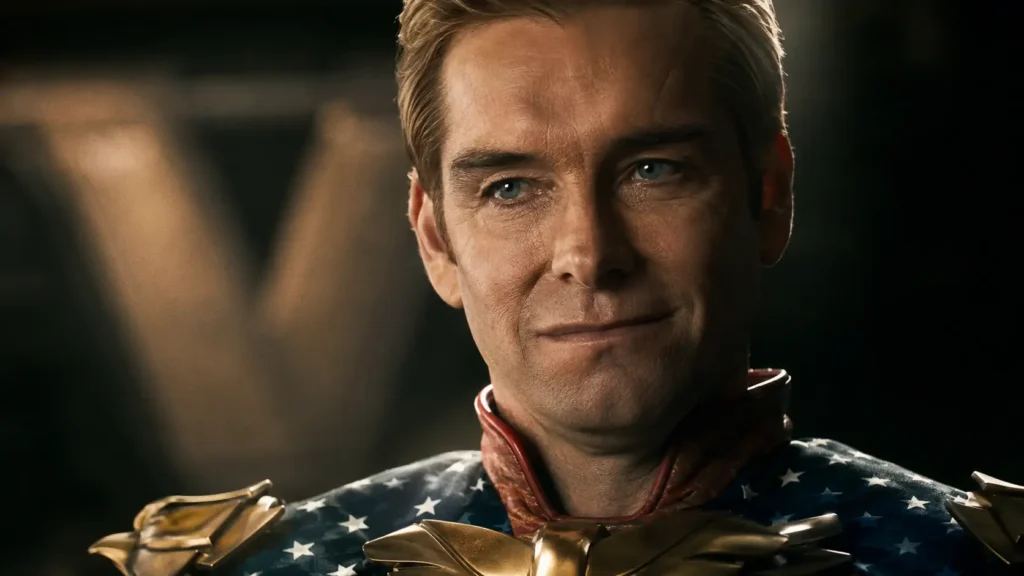
From his first polished TV smile in Season 1, Homelander (Antony Starr) was never written as a traditional supervillain who wants to rule the world because it is fun. He wants to rule because he is empty. Vought International raised him to be worshipped. Every applause track, every focus group, every cover of Vought News Network told him he was born better. When reality did not match the script, he punished it.
That is the engine of homelander arc the boys:
| Layer | What the show sells | What John actually is |
| Public image | Patriot, protector, father figure | Performer reading a teleprompter |
| Power | God among men | Shield against vulnerability |
| Relationships | Ryan’s dad, Becca’s obsession, Butcher’s nemesis | Attachments as ownership |
| Politics (S4–S5) | President, savior | Toddler with nuclear launch codes |
| Finale | Fallen tyrant | Mortal man begging on camera |
US fans who loved him as a “chaotic icon” were always loving a character designed to expose stan culture. The homelander season 5 death is not a betrayal of that energy. It is the receipt.
HollyFlix Pro Tip: Binge Seasons 1 and 3 back to back on Prime Video US before rewatching the finale. Season 1 shows the mask slipping in private. Season 3 gives you the “blood and bone” handshake that pays off in Episode 8. You will feel the arc click in a way a single episode rewatch never delivers.
Origin Story: The Lab, the Lie, and the Mother Who Was Not There
Homelander’s trauma is not subtle, and the show refuses to use it as excuse. It uses it as fuel.
Compound V made him strong. Madelyn Stillwell (Elisabeth Shue) made him obedient. Rebecca Saunders made him obsessed with the idea that one person could see him as human. None of them gave him a self.
Early seasons plant three seeds that bloom in his homelander the boys ending:
- Abandonment: He was raised in sterile corporate care, not a family. Every bond is transactional.
- Surveillance: He hears hearts, smells fear, knows when crowds lie. He cannot tolerate being unseen.
- Performance: Smiling for cameras is easier than feeling. Rage is the only honest emotion he trusts.
When he discovers his “mother” figure in Season 2 and destroys her, it is not justice. It is panic. If the person who defined him was fake, what is he? The answer he chooses: still god, just angrier.
That choice matters for homelander finale explained discourse. Kripke did not write a tragic hero who lost his way. He wrote a narcissist who escalated because the world kept rewarding the mask.
Season by Season: How the Arc Builds Toward Humiliation
Season 1: The Smile That Hides the Scream
Homelander enters as America’s sweetheart with a body count he hides from C-SPAN. His rivalry with Billy Butcher (Karl Urban) is personal before it is political: Butcher sees the monster; Homelander sees a bug who will not worship.
Key character beats:
- The plane scene (still one of the most cited horror moments in modern TV) proves he will let innocents die to protect brand.
- Stillwell’s death shows he confuses love with control.
- The milk meme became comedy, but in context it is dissociation: a man who can destroy cities fixates on comfort because he has nothing else.
US fan reaction then: “He is unhinged but iconic.” The show heard you. It spent four more seasons making sure icon status became a trap.
Season 2: Family as Weapon
Ryan arrives as Homelander’s legacy project. He does not want a son. He wants proof he is not alone in the universe. When Ryan bonds with Butcher and Becca’s ghost haunts both men, Homelander doubles down on possession. Stormfront (Aya Cash) radicalizes him further. White supremacy cosplay as ratings strategy is peak Boys satire: evil with a marketing deck. Homelander learns that fascism polls well if you grin while doing it.
Character shift: from hidden monster to public radical. The arc inches toward politics.
Season 3: The Handshake That Signs His Death Warrant
Season 3 is the psychological bridge to the finale everyone argued about online.
Homelander and Butcher agree to leave the world “scorched earth, shock and awe, blood and bone.” No armies. No Avengers portal. Personal war.
Homelander also meets Soldier Boy (Jensen Ackles), the only mirror who reflects what he could have been: violent, famous, and still somehow more honest about it. Their dynamic feeds his insecurity. If another supe can steal the spotlight, is Homelander still the main character?
By season’s end he is more unstable, more famous, and more convinced the crowd will always choose him. That belief is what Episode 8 destroys on camera.
Season 4: President Homelander and the Cult of Personality
Homelander becomes President of the United States. Not as satire garnish. As logical endpoint.
A nation that stanned a rapist, a murderer, and a corporate puppet finally gave him the only office bigger than the Seven. Character wise, this is peak delusion: he thinks the country is him.
Ashley Barrett (Colleen Foley) embodies enabler culture. Firecracker and the media ecosystem show how outrage farms power. Homelander stops pretending to be Superman and starts acting like a cable news host with flight.
For arc readers, Season 4 answers why the Oval Office matters in homelander season 5 death. He did not die in a random alley. He died in the room he stole, on the medium he mastered: television.
Season 5: Stripping the God Before the Kill
The final season is a sustained insult to Homelander’s self image:
- Multiple characters tell him without powers he is nothing.
- He stuffs Soldier Boy back in a tube rather than risk a fair fight (cowardice as strategy).
- He clings to Ryan while Ryan drifts toward humanity.
- He survives Episode 6’s immortal tease only so the audience cannot accuse the writers of a cheap off screen death.
When Kimiko’s de powering blast hits in the finale, the show is not punishing Homelander with a new weapon. It is fulfilling a promise it made all season: remove the cape, see the man.
The Psychology of Homelander: Narcissism, Fatherhood, and the Need to Be Loved
Therapists on TikTok had a field day after the finale, and for good reason. Homelander checks nearly every box of grandiose narcissism in the clinical sense, played for horror instead of Dr. Phil clips.
Core traits the show dramatizes
| Trait | How it shows on screen | Finale payoff |
| Grandiosity | “I am the Homelander” branding | Catchphrase cut off mid sentence |
| Lack of empathy | Plane, Maeve, Ryan as props | Begging with zero sincerity |
| Rage when challenged | Stillwell, Starlight, Butcher | Pathetic fistfight when mortal |
| Need for supply | Crowds, ratings, Vought | Live TV humiliation as anti supply |
| Splitting | Worship me or die | Ryan chooses neither |
Ryan: the son who broke the script
Ryan (Cameron Crovetti) is the emotional keystone of homelander finale explained analysis. Homelander’s entire late arc assumes Ryan is Homelander 2.0. Genetics as destiny.
Ryan’s “get fucked” moment in the Oval Office is short on screen time and massive on meaning. A narcissistic parent does not fear defeat from enemies. They fear abandonment by the one person meant to mirror them. When Ryan sides with humanity, Homelander’s myth dies before the crowbar swings.
Post finale US fan split:
- Team Symbolism: “Ryan killed his father’s soul on air.”
- Team Action: “Ryan should have laser fought him.”
- Team Arc: “Both can be true. The show chose psychology over anime.”
Kripke picked psychology. That is why this ending belongs in a character study, not a power scaling debate.
Butcher: the shadow that knows his name
Butcher is not Homelander’s opposite. He is the mirror that refuses to flatter. Their bond is obsessive because each man defines himself through the other. Butcher lost Becca. Homelander stole Ryan’s narrative. Season 5’s crowbar finish is intimate because it was always personal, not cosmic.
When Butcher beats a depowered Homelander, he is not winning a supe war. He is proving a thesis the show repeated for years: without Compound V, you are just another scared man.
HollyFlix Pro Tip: Pair this article with our Season 5 ending explained guide for plot mechanics, and our Episode 8 scene breakdown if you need timestamps. This post stays in John’s headspace on purpose.
Antony Starr’s Performance: Why the Humiliation Lands
You cannot write homelander the boys ending without talking about the actor. Starr played Homelander as three simultaneous performances:
- The commercial: chin up, voice warm, eyes dead.
- The predator: stillness before violence, smile never reaching skin.
- The child: lip tremble, voice crack, desperate bargaining.
The finale demands number three in front of cameras. That is career high wire work. Homelander begging for Becca back via shapeshifter, offering Vought, offering anything, is not camp. It is revulsion by design.
US critics from Esquire to Den of Geek noted the same split: viewers who wanted epic scale called it rushed. Viewers who tracked the arc called it inevitable. Starr’s performance is the tiebreaker. You either watch a villain get what he always was, or you watch your power fantasy collapse. The show wants the second reaction from Homelander stans. That discomfort is the art.
The Oval Office Death: Why Humiliation Beats Apocalypse
Let’s address the loudest homelander season 5 death complaint head on: “Where was scorched earth?”
Marketing quoted Homelander’s Season 3 threat. Fans imagined cities burning. Kripke delivered a man with a bloody nose crying while C SPAN energy cameras rolled.
Why humiliation is the correct ending for this character:
| Alternative ending | Why the show rejected it |
| Homelander wins | Undoes entire satire |
| Homelander dies in secret | Lets Vought rewrite history |
| Homelander dies at full power | Proves only bigger violence stops him |
| Homelander escapes | One injection from reset |
| Homelander dies depowered on TV | Destroys myth AND body |
Homelander’s brand was invincibility. Strip powers, broadcast begging, cut off his catchphrase, kill him with a hardware store tool wielded by a mortal enemy. That is not “small.” That is reputational annihilation.
In interviews (including with The Hollywood Reporter), Kripke argued mercy would have been letting him walk. Pain he never felt as a god is the horror. US Twitter threads that called the death “merciful” missed the point on purpose: the show wanted you to feel how pathetic tyranny looks without special effects.
The unfinished catchphrase as character thesis
“I am the Homelander…”
He never finishes “and I can do whatever the f— I want.” Symbolically, the sentence dies with his authority. Legally, narratively, sexually, politically, he spent five seasons doing whatever he wanted. The finale answers: not anymore.
Homelander fans meme that line because it is seductive. The ending robs the seduction in real time. That is braver than another sky beam.
Homelander vs Other TV Anti Icons (What Makes Him Different)
| Character | Show | Similar energy | How Homelander differs |
| Walter White | Breaking Bad | Ego + performance | HL never “broke bad”; he started fake |
| Joe Goldberg | You | Obsession masked as love | HL has national platform |
| Omni Man | Invincible | Father legacy violence | HL wants worship, not conquest |
| Soldier Boy | The Boys | Toxic masculinity vintage | HL hides behind modern PR |
| Homelander S1 | Homelander S5 | Same face | Mask off, no redemption offered |
US Fan Reactions: Stan Wars, Memes, and the Backlash Timeline
Within hours of the May 20, 2026 finale on Prime Video, homelander finale explained trended next to copium.
Sample reactions (paraphrased from X and Reddit):
- “They turned the main character into a bitch on live TV. Masterpiece.”
- “Episode 6 made him immortal for no reason.” (Counter: it raised stakes for depowering.)
- “Starr deserves an Emmy for that whimper scene.”
- “I wanted Homelander vs Soldier Boy round two, not crowbar craft.”
The stan war is meta commentary. Homelander’s in universe fans worshipped him despite evidence. Out of universe fans did the same. The finale forces both groups to watch the idol beg. Kotaku and similar outlets noted how uncomfortable that is for viewers who rooted for him like Walter White, missing that the satire targets them too.
Homelander fans are NOT okay because the show finally said the quiet part loud: you were never worshipping power. You were worshipping branding.
Legacy: What Homelander Leaves Behind in the Boys Universe
Homelander dies, but Vought does not evaporate. Ashley’s impeachment epilogue, Ryan’s haunted stare, Hughie’s choice to stop Butcher, and the upcoming Vought Rising prequel era all echo his shadow.
Character legacy checklist:
- Ryan: Can he be better, or is trauma cyclical? The finale bets on choice over DNA.
- Starlight / Annie: Survives as the celebrity who fought the machine Homelander embodied.
- Butcher: Wins the fight, loses the moral high ground immediately after. Homelander’s death is not the end of the story; it is the trigger for Butcher’s own collapse.
- America: Still addicted to supe spectacle unless the audience learns the lesson. Satire’s open question.
Conclusion: The Boy Who Wanted Applause and Got a Crowbar
Homelander the boys ending is not a plot twist. It is a character sentence passed in public.
John Gillman was never a god. He was a product. A son who was failed. A president who was elected by a culture that confused cruelty with strength. His homelander season 5 death works because the show spent seven years proving the only thing scarier than Homelander at full power is Homelander without it: small, mortal, and finally visible.
If you wanted apocalypse, you wanted the wrong show. The Boys was always about the camera. Homelander lived on it. He died on it. And Antony Starr made sure you could not look away.
Now we want your take. Did the humiliation feel earned, or did you want a bigger final boss fight? Drop your hottest Homelander take in the comments. Then binge the full series on Prime Video US and read our Season 5 ending explained for every twist after the crowbar drops.
Homelander fans are still not okay. Good. Neither is the country that made him President.
FAQ: Homelander’s Ending and Arc
How does Homelander die in The Boys Season 5?
Kimiko’s de powering blast strips Homelander, Butcher, and Ryan of their abilities in the Oval Office. Butcher beats Homelander while the fight airs live. Homelander begs and tries to finish his catchphrase. Butcher kills him with a crowbar.
Why was Homelander’s death so humiliating?
Eric Kripke and the writers planned to prove Homelander is a coward without powers. Public begging on television destroys his invincible brand more than a secret assassination would.
Did Ryan kill Homelander?
Ryan rejects his father emotionally and helps set up the depowered fight, but Butcher delivers the physical kill. Ryan’s line afterward makes clear killing Homelander does not make Butcher a hero.
Is Homelander’s arc complete or did the show rush it?
Opinions vary in the US fanbase. From a character arc view, the seeds (emptiness, performance, political rise, “you are nothing without powers”) were planted for multiple seasons. Pacing complaints focus on Episode 8 fitting many plots into one hour, not on Homelander’s psychology reversing suddenly.
Where can I watch The Boys finale in the US?
All five seasons, including “Blood and Bone,” stream on Prime Video US. Full season binge is available now.
Does Homelander get a redemption arc?
No. The show denies last minute redemption. His final moments are bargaining and fear, consistent with narcissistic collapse rather than growth.
How does Homelander compare to Soldier Boy?
Soldier Boy represents old school violent masculinity. Homelander represents focus grouped fascism with a smile. Season 5 has Homelander avoid a fair rematch, underscoring his cowardice.
Will Homelander return in Gen V or Vought Rising?
Homelander is dead in the main timeline. Prequel projects may explore Vought history, but Antony Starr’s main saga concluded in Season 5 Episode 8.

They are a passionate group of entertainment writers, pop culture enthusiasts, and streaming industry analysts dedicated to bringing readers the latest updates from the world of movies, TV shows, anime, web series, and digital entertainment. From honest reviews and streaming guides to celebrity news, fan theories, and trending entertainment insights, the team delivers engaging, timely, and reader-focused content designed for modern binge-watchers and entertainment fans worldwide. Team HollyFlixTV helps audiences discover what’s worth watching across platforms like Netflix, Disney+, Prime Video, Hulu, and beyond.